
TAMARIND WOOD
- anjali nautiyal
- Jan 17, 2023
- 3 min read

Well, who can compete with nature when it comes to color, art, and aesthetics? That’s what Tamarind wood will make you feel when you look at its heartwood. It gives fascinating looks to the wood and to thus to the products they are inlaid to. We at The Beehive India celebrate it and promise to take this to another level.
Tamarind wood’s bio update
Tamarind wood is also known as Imli wood in India. It is hardwood and is difficult to cut. It is available in a pretty variety of colors that we will cover later. The grains are wavy and interlocked with a medium-uniform texture. And this density leads to difficulty in working experience with it.
The species belong to the tropical portions of Africa, though it is found in many parts of the world.
It grows 50-80 feet tall, whereas its trunk diameter counts: 2-3 ft. It doesn’t have any specific odor.
This wood is traditionally used to make coal. Nowadays, it is also used for making furniture, carvings, trend objects, as well as other small specialty wood items.
What do we see in it?
We at Beehive India believe in converting Imli wood, not into coal but into beautiful products by enhancing its grain.
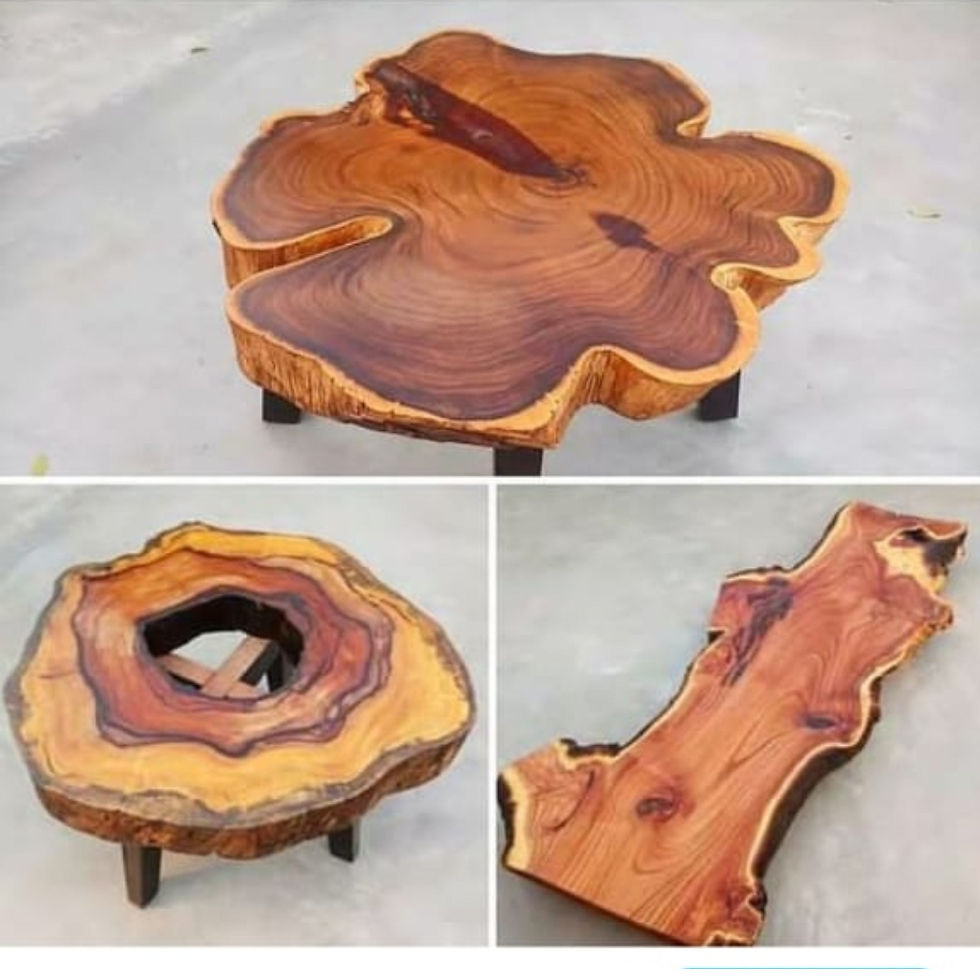
Cross Sections of this wood have natural aesthetics that we use to make products. The grains in cross sections look more beautiful than linear grain - it is more communicative. So we decided to create more creative artwork out of it.
The advantage we use it to is...
Well, it is available in a pretty variety of colors. It comes in off-white to the tones of brown, majorly in deep reddish-brown color and sometimes with a purplish hue. The sapwood comes in a pale yellow that easily differs from the dark heartwood. After reaching a certain age, it tends to become hollow from the center. So it becomes important to cut the timber for application use as the tree reaches its death stage.
We also noticed that when it is left to rot, white portions also change color. So we use it to aesthetic advantage.
We let the wood talk.
The natural change in appearances gives many interpretations. That’s what we celebrate about it.
For instance, once the wood was left out in the rain, it changed its color gradually to shades of blue. The blue stain fungus led to the change in color, and we started playing around with it. The cross-section communicated a scenic view of the landscape with mountains; to some, it gave the feeling of the beach side.
Other than that, the trunk of the wood is not perfectly cylindrical; it keeps on twisting and turning. One trunk we encountered had a glimpse of a man’s head with a dark patch in the center. Eventually, the patch turned into a hole. We held on to its natural art and let it communicate to the people. Some people see it as a headshot of a man’s head; for some, it depicts a brain or black hole inside the head.
Retaining the hole of Imli wood can also be used as an advantage of the natural aesthetics of the tree. We also educate customers about it.
In that way, we at Beehive India give shape and create space for the wood, and let nature do the talking.
Our plans
We have now restricted ourselves to smaller products - Coasters, and Trivets. However, we are certainly looking to make a full piece of furniture.
For sustainability - We don’t put big patches of it. To make use of waste, we are also planning to use color features for advantage by putting it into the ply and making a table out of it.
There is a possibility to make bigger artwork out of it that we are certainly looking into.
Comments